Eight ingredients are printed on the HoneyFil label, each on its own line. This page takes them one at a time, in the order they appear on the panel: what the ingredient is, where it comes from and why a men’s daily formula would carry it.
What this page does not do is state quantities. The manufacturer has published no itemised breakdown, and the Supplement Facts panel on your own bottle is the authority on amounts. Anything you read here about an ingredient describes that ingredient, not a claim about the finished formula.
Vitamin B3 (Niacin)
Every cell runs its energy chemistry through niacin-derived coenzymes. The body keeps no reserve of it, so a daily panel names it first.
Niacin is the third of the B vitamins and one of the few whose job can be stated in a sentence: it becomes NAD and NADP, the two coenzymes that carry electrons through the reactions releasing energy from carbohydrate, fat and protein. Nothing in the cell runs its energy chemistry without them.
It is water soluble, which means it is not banked. What the body does not use it excretes, and tomorrow's supply has to arrive tomorrow. That single property is why niacin turns up first on so many daily panels, HoneyFil included, and why a once-daily format suits it better than an occasional one.
Zinc (as Zinc Oxide)
Hundreds of enzymes will not fold or function without a zinc atom in place. Men's formulas have treated it as non-optional for years.
Zinc's reach is unusual. Several hundred enzymes will not adopt their working shape without a zinc atom held at the centre, which puts it inside protein synthesis, cell division, immune signalling and the maintenance of normal testosterone levels all at once.
Storage is the catch. The body holds very little in reserve and spends it continuously, so intake has to keep pace rather than catch up. Men's formulas treat it as close to compulsory for that reason. HoneyFil lists it as zinc oxide, one of the standard forms used in supplement manufacture.
L-Citrulline
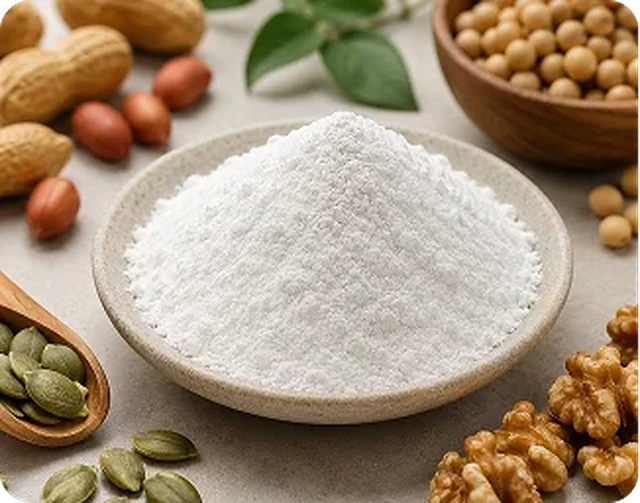
It is not used as citrulline. The kidney converts it to arginine, and arginine is the doorway to nitric oxide and open blood vessels.
L-citrulline is the rarer half of a pair. Arginine is the amino acid that actually feeds nitric oxide production and relaxes the smooth muscle lining blood vessels, but arginine taken by mouth is largely dismantled in the gut before it reaches circulation. Citrulline is not: it passes through, reaches the kidney and is converted to arginine there.
The practical result is that citrulline raises circulating arginine more reliably than arginine itself does. That indirect route is why circulation formulas reach for it, and why it sits on the HoneyFil panel alongside pine bark rather than on its own.
L-Carnitine
Fat that cannot cross the mitochondrial membrane cannot be burned. Carnitine is the carrier that gets it across.
L-carnitine is a carrier, not a fuel. Long-chain fatty acids cannot cross the inner mitochondrial membrane unaided; carnitine binds them, walks them across and releases them on the other side, where beta oxidation can begin. Without that shuttle the fat simply waits outside the furnace.
The body makes its own from lysine and methionine, and meat supplies more. Its presence in a men's daily formula points at the same place as niacin: the part of metabolism that turns stored fuel into something usable. HoneyFil names it separately rather than folding it into a blend.
Pine Bark Extract
Standardised on proanthocyanidins from the bark of the French maritime pine, a polyphenol group tied to vascular formulas.
The bark of the French maritime pine, Pinus pinaster, is dense in proanthocyanidins — a family of polyphenols also found in grape seed and in cocoa. Extracts are standardised on that fraction, which is what makes one batch comparable to the next.
Interest in the group has always centred on the vascular system and on antioxidant behaviour, which is why it appears in circulation-oriented formulas rather than in general multivitamins. In HoneyFil it sits beside L-citrulline, and the two approach the same territory from different directions.
Maca Root Extract
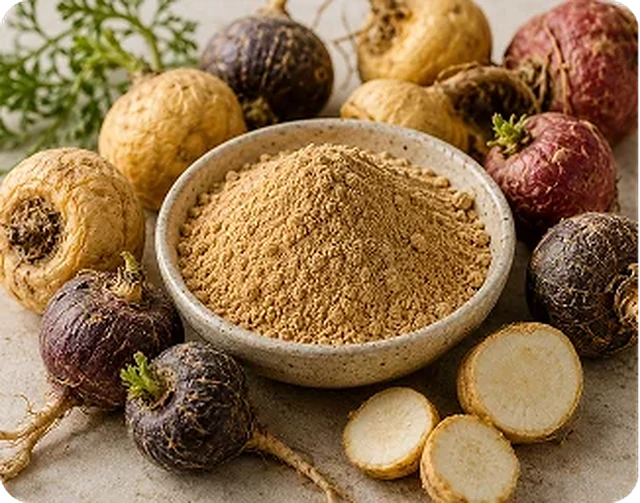
Grown on the Peruvian altiplano at altitudes where almost nothing else will crop. Eaten as a vegetable there long before it was dried.
Maca is a brassica root, a relation of the radish, grown on the Peruvian altiplano at four thousand metres and above — ground where frost, wind and thin air defeat nearly every other crop. It has been food there for centuries, dried and stored through winters, long before anyone thought to concentrate it.
Its traditional reputation in the Andes is about stamina and staying power under hard conditions, and that reputation is what carried it into western men's formulas. Colour varies considerably between tubers, from pale cream through to near black. HoneyFil uses a root extract.
Grape Skin Extract
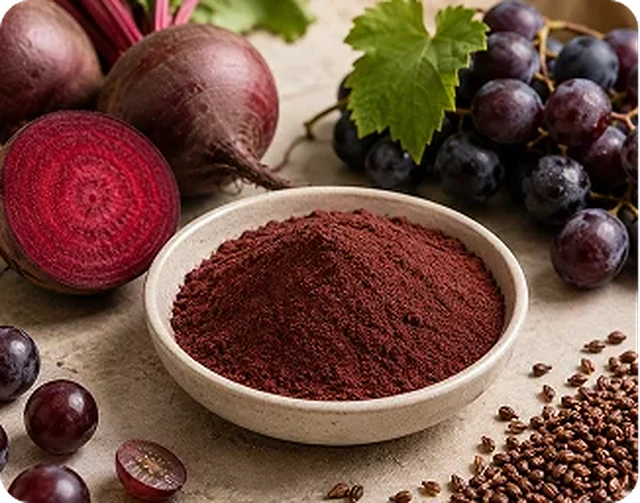
Winemakers press the skin and discard it. The polyphenol load of the fruit is concentrated in exactly that discarded fraction.
Grape skin is the fraction winemakers press and discard, and it is also where the fruit concentrates its polyphenols — the anthocyanins that give red grapes their colour, plus resveratrol and a range of related compounds. The juice carries comparatively little of it.
Extracting from the skin rather than the whole fruit is therefore a decision about density, not thrift. On the HoneyFil panel it joins pine bark on the polyphenol side of the formula, drawn from a different plant and a different part of it.
Saffron Stigmas Extract
Each crocus yields three crimson stigmas, all of them picked by hand. Nothing else on this label costs as much per gram.
Saffron is the dried stigma of Crocus sativus. Each flower produces exactly three, every one of them lifted by hand during a short autumn window, which is why the spice has been the most expensive agricultural product in the world for most of recorded history.
Its active compounds — crocin, safranal and picrocrocin — carry the colour, the aroma and the bitterness respectively. In supplement work it appears at small inclusions for exactly that reason. Nothing else named on the HoneyFil label approaches it in cost per gram.
Three things this page leaves out
No amounts, for the reason above. No comparison against any other product, because this is the official information page for one formula and not a ranking. And no clinical claims attached to HoneyFil itself: the reference material below concerns individual ingredients studied on their own, which is a different thing from a finished gummy.
The full directions are on the directions page, and the three package sizes are set out on the packages page.